Digital SAT · Math · Unit 4 · Geometry & Trigonometry
Lesson 4.3 · Trigonometry
On the test: 1–2 questions a test — almost always a right triangle and one ratio; now and then a radian angle on the unit circle
Big idea. A trig ratio is just a fraction of two sides, and it belongs to the ANGLE, not to the size of the triangle. Name the sides from the angle you are asked about (opposite, adjacent, hypotenuse), find any missing side with Pythagoras, and read the fraction. The two acute angles of a right triangle swap sine and cosine. On the unit circle, cos is the x and sin is the y.
🎛 Move it · SOH · CAH · TOA
Pick a ratio and watch which two sides light up. Grow the triangle — the ratio holds. Turn the angle — it changes.
sin A = opposite / hypotenuse = 6.02 / 10 = 0.6 (SOH · CAH · TOA).
Drag the size: every side grows, the ratio does NOT move — it belongs to the ANGLE. That is why similar triangles have equal sin, cos, tan. Drag the angle: now it changes.
Given a ratio like cos A = 3/5? Build the sides as 3 parts and 5 parts (and 4 by Pythagoras), then find what one part is worth.
- 1
the three names
The hypotenuse faces the right angle. Opposite faces YOUR angle. Adjacent touches your angle (and is not the hypotenuse).
- 1
📋 The question · SAT · August US 2024 · Math 800 Book Q11
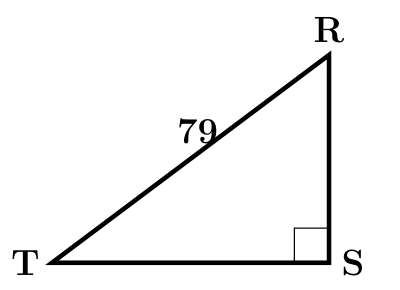
In the triangle shown . What is the value of ?
(type the answer)
what sin R needs
August US 2024: the side opposite is — not given.
- 1
📋 The question · SAT · May US 2024 · Math 800 Book Q6
In , is a right angle and the length of is 204 millimeters. If , what is the length, in millimeters, of ?
- A)255
- B)204
- C)153
- D)51
build
May US 2024: a 3-4-5 triangle scaled by some .
🎛 Move it · where the values come from
Tap a value: it is read straight off one of the two special triangles.
| sin | cos | tan | |
|---|---|---|---|
| 30° | |||
| 45° | |||
| 60° |
🎛 Move it · the special triangles
45-45-90 and 30-60-90 — the same shapes as in Lesson 4.2.
45-45-90 = half a square. Legs equal (x), hypotenuse x√2 — the square’s diagonal.
Perimeter = 2x + x√2 = 13.66. Seeing “18 + 18√2”? Factor: x(2 + √2) = x√2(√2 + 1), so the HYPOTENUSE x√2 = 18. Going back: leg = hypotenuse ÷ √2.
- 1
📋 The question · Gen Z Study · special values
What is the value of ?
(type the answer)
add them
, .
🎛 Move it · two angles of a right triangle
The red side is opposite A and next to B.
- 1
📋 The question · SAT · May 2024 · Math 800 Book Q8
In right triangle , the sum of the measures of angle and angle is 90 degrees. The value of is . What is the value of ?
- A)
- B)
- C)
- D)
R + S = 90
May 2024: B — no computing.
- 1
the identity
The same fact as Rule 5, written with one letter.
🎛 Move it · the ramp
Change the height and the run. tan θ is the slope; the law caps it at 1/12.
tan θ = rise ÷ run = 22.3 ÷ 300 = 0.074 — tan is the SLOPE of the ramp. The law wants tan θ ≤ 1/12 ≈ 0.0833: legal.
Turn the limit around: h/x ≤ 1/12 ⇔ x ≥ 12h = 267.6. A smaller tan needs a LONGER run — the inequality flips because x is on the bottom.
- 1
📋 The question · SAT · March 2024 · Math 800 Book Q3
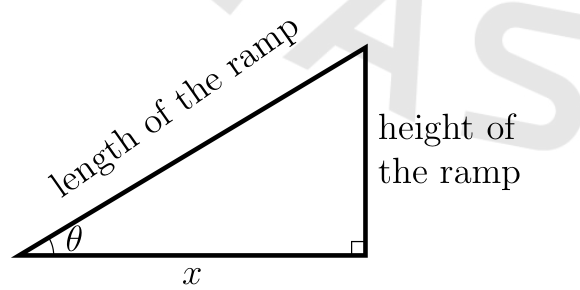
According to a US law, ramps for use by the general public must form an angle with the ground such that . If the ramp in the figure conforms to this law and the height of the ramp is 28.2 inches, what is the least possible value of , in inches?
(type the answer)
the law
March 2024: height over run.
- 1
📋 The question · SAT · May 2024 · Math 800 Book Q7
In triangle , angle is a right angle, the measure of angle is , and the length of is 22 units. If the area, in square units, of triangle can be represented by the expression , where is a constant, what is the value of ?
(type the answer)
the other leg
May 2024: faces , touches it.
🎛 Move it · degrees ↔ radians
Turn the angle: degrees and radians side by side.
180° = π radians (half a turn), 360° = 2π. So: degrees → radians: × π/180 · radians → degrees: × 180/π.
A radian is the angle whose arc is exactly one radius long — so the arc is always θ (in radians) × r. Whole turns (2π) can be added to any angle and land in the same place.
🎛 Move it · the unit circle
Turn θ: the point is (cos θ, sin θ). Watch the signs change by quadrant, then add whole turns — the point doesn’t move.
On a circle of radius 1, the point at angle θ IS (cos θ, sin θ): cos = how far across, sin = how far up. The blue and red legs and the radius make a right triangle with hypotenuse 1 — so sin² + cos² = 1 (Pythagoras).
Quadrant 3: Tan positive (sin, cos negative). The size comes from the reference angle 45° (the angle to the nearest x-axis); the quadrant only decides the signs.
Add full turns (2π each) — the point does not move: 5π/4 lands where 5π/4 does. To simplify a huge angle, subtract 2π until it is between 0 and 2π.
- 1
📋 The question · Gen Z Study · unit circle point
On the unit circle, the point at angle from the positive -axis is:
- A)
- B)
- C)
- D)
axis angles
Three quarter-turns: straight down. D.
🎛 Move it · ASTC and the reference angle
Pick a reference angle: its four relatives light up, one per quadrant. Then pick a function and a sign — only the quadrants that fit stay lit.
ASTC — “All Students Take Calculus”, counter-clockwise from quadrant 1: All three positive in Q1 · only Sin in Q2 · only Tan in Q3 · only Cos in Q4. (Why: cos is x, sin is y, tan is y/x — read the signs of x and y in each quadrant.)
Reference angle = the acute angle to the nearest x-axis. From an angle to its reference: Q1: ref = angle · Q2: ref = 180° − angle (π − angle) · Q3: ref = angle − 180° (angle − π) · Q4: ref = 360° − angle (2π − angle).
Backwards — the corresponding angles: one reference angle θ gives one angle in each quadrant: θ, 180° − θ, 180° + θ, 360° − θ (radians: θ, π − θ, π + θ, 2π − θ).
- 1
the words
Quadrants I, II, III, IV, counter-clockwise from the top right.
- 1
what it is
It gives the SIZE of sin, cos, tan; ASTC gives the SIGN.
- 1
📋 The question · Gen Z Study · coterminal
Which angle between and ends in the same place as ?
- A)
- B)
- C)
- D)
subtract 2π
B.
In the triangle shown, . What is the value of ?
Take with you
- ▸SOH-CAH-TOA, named from YOUR angle: opposite faces it, adjacent touches it, the hypotenuse faces the right angle. Sin and cos are never above 1.
- ▸Missing side? Pythagoras first. A ratio like 3/5 builds the sides as 3p, 4p, 5p — find p.
- ▸30°: 1/2, √3/2, √3/3 · 45°: √2/2, √2/2, 1 · 60°: √3/2, 1/2, √3. tan = sin ÷ cos.
- ▸A + B = 90 ⇔ sin A = cos B; cos(90 − x) = sin x; sin² + cos² = 1.
- ▸tan is a slope (rise ÷ run); with x in the denominator, “tan ≤ c” becomes “x ≥ height/c”.
- ▸π = 180°. On the unit circle the point is (cos θ, sin θ); whole turns (2π) change nothing.
- ▸ASTC (All Students Take Calculus): Q1 all +, Q2 sin +, Q3 tan +, Q4 cos +. Reference angle: 180 − θ, θ − 180, 360 − θ; back again: θ, 180 − θ, 180 + θ, 360 − θ — the reference gives the size, ASTC the sign.